Compiled by Ashley Roach-Freiman
University of Memphis
Est. 2025
Background
My interest in Taylor Swift began, like so many, in 2020, the year Folklore was released. The album was getting so much attention that I listened to it, sort of despite myself. I liked it, though it wasn’t top of my 2020 listens (I think Fiona Apple won that with Fetch the Bolt Cutters). When Midnights was rolled out in 2022, I was attracted to the muted jewel tones and 70s vibe of the aesthetic and, through digging through the lyrical content of those “13 sleepless nights,” I became a real fan. Though I couldn’t afford to attend the juggernaut of the Eras Tour, I did become maybe a little obsessed to the extent that I started reading not just fan forums and social media accounts of Swifties, but also academic articles about Swift herself, her influence and fandom, her songwriting, her references, her cultural influence.
What I found was so fascinating that I proposed an Honors Forum for students here at the University of Memphis. What I wanted was someone to talk to about Taylor. Even better, a whole room full of people.
When I was asked to present current research interests to the University Libraries Colloquium, I chose Taylor.
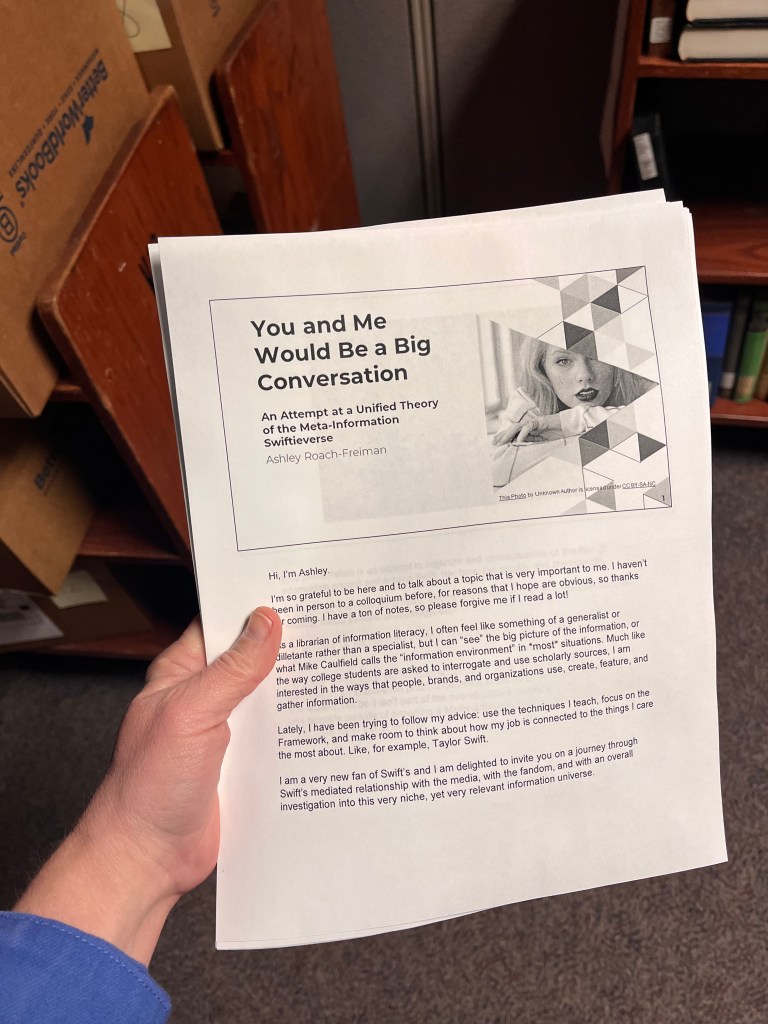
University Libraries Colloquium
April 21, 10-11:30AM, McWherter Library 2nd Floor Commons
From the “Between the Stacks” newsletter, April 2023: Ashley Roach-Freiman, Library Instruction Curriculum Coordinator, will present “You and Me Would Be a Big Conversation: An Attempt at a Unified Theory of the Meta-Information Swiftiverse.” Taylor Swift is a true American pop star, maintaining the persona of “good girl” creative icon while navigating fame, fandom, and the music business. Alongside being a prolific mega-hit maker, she’s notable for self-mythologizing by playing with and manipulating “texts” such as fan perceptions, online platforms, and the lyrical and musical themes of her own oeuvre. In this presentation, Ashley will connect concepts of the Association of College & Research Libraries (ACRL) Framework for Information Literacy to the Swift media universe and the fandom, a maelstrom of information that upends received notions of value and scholarship.
That Fall semester in 2023 was transformative and fun. We read and annotated some of the articles that became the Bibliography, puzzled over the meanings of scholarly jargon, and celebrated the complexity of our Queen. We also did some ranking:
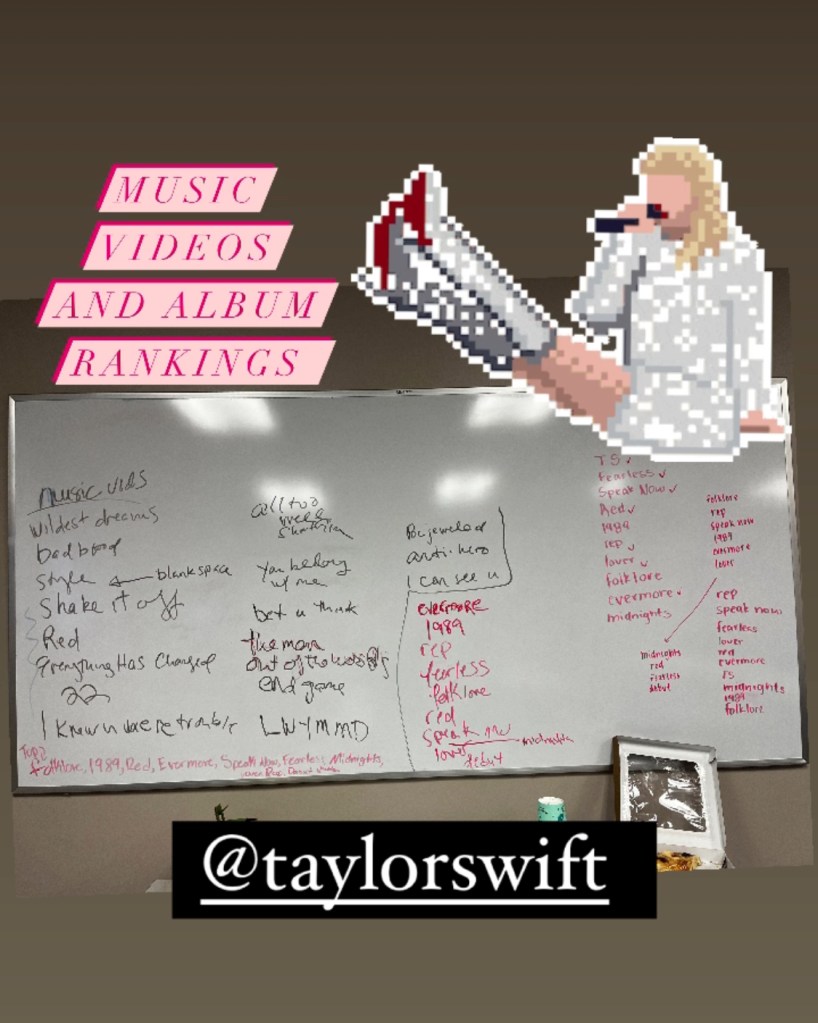
How did Folklore end up under Fearless? Is the Bad Blood video really better than the video for All Too Well (10 Minute Version) (Taylor’s Version)?
The next semester, I taught Taylor again, but this time I leaned into the literary references in her discography, especially centering The Tortured Poets Department.
The Bibliography
Welcome to the Bibliography. The Zotero version is linked; feel free to join the Zotero group for access to documents as they are added.
Contemporary Music Review
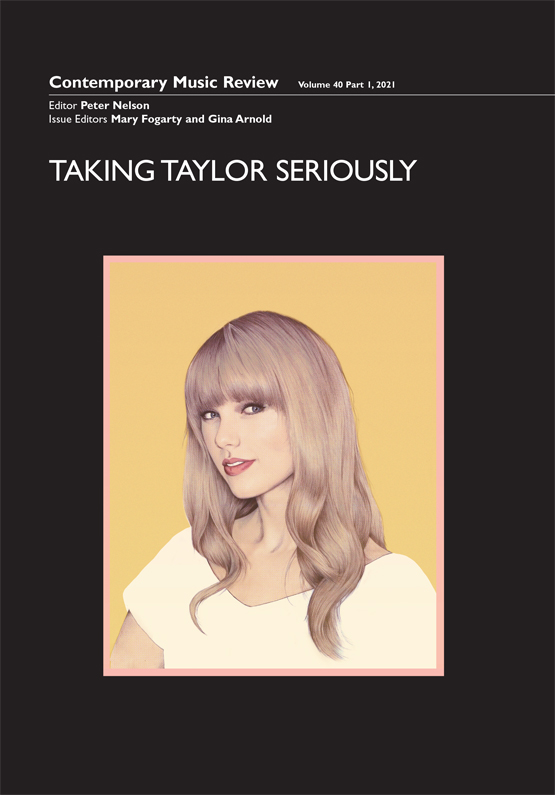
Contemporary Music Review
2021
Special Issue: Taking Taylor Seriously
I reached out to the editors and publishers of this special issue to request a reprint. Not without paying $335 for a new issue! Unfortunately, the issue is not available open access although it is beautifully edited by Mary Fogarty & Gina Arnold. I’ve spent most of my concentrated reading time here, though many articles exist beyond it, as you can see below. If you’d like to access one of those articles, I recommend using your closest library’s interlibrary loan service (or drop me a quick email).
My Process
I periodically search for articles on the University Libraries’ metasearch, EBSCO Discovery.
I also subscribe to Google Scholar alerts for mentions of “Taylor Swift.”
When reviewing articles, I check references to see if they merit scholarly notice. Peer review is not the deciding factor here, though it weighed heavily in my criteria. I was cautious not to include theses and dissertations (perhaps a second category?), though I did include one that was published here at the University of Memphis Undergraduate Research Journal QuaesitUM. Some magazine articles were included, though only a couple of recent ones. Frankly, there are too many magazine and news articles to compile.
I keep everything in a Zotero group, updating the metadata so that the citations and links reflect the published nature of the work to the best of my ability.
I wasn’t /am not exhaustive in my proofreading or compiling, so if you would like to make suggestions, please contact me: amroach@memphis.edu
I’ve done my best to not take citations too seriously. I believe that citation is mostly a form of scholarly gatekeeping, academic tribulation to weed out “lesser prepared” students and provide favors to disciplinary friends. Despite all that, I stuck with APA format because I am the most familiar with it.
In compiling this bibliography, I came across this enlightening analysis of the scholarship of Taylor by a nanochemist (!) and science writer: The Research Eras Tour – the Scholarly Side of Taylor Swift. I appreciate how the author, Suze Kundu, groups the articles by Eras, showing how the scholarly conversation around Swift has shifted as her music and cultural persona have evolved.
I am on the Editorial Board of The Manuscript!
The Manuscript: Journal of Taylor Swift Studies (JOTSS): Housed within Binghamton University’s Harpur College, The Manuscript: Journal of Swift Studies (JOTSS) is a graduate student-run, peer-reviewed publication committed to advancing Taylor Swift Studies through interdisciplinary inquiry. We publish original research that examines Swift’s works, influence, and legacy through various theoretical, methodological, and practical approaches.
The Bibliography
Dear reader, get out your map, pick somewhere, and just run.
Books
Frederick Daugherty, K., ed. (2024). Invisible strings : 113 poets respond to the songs of Taylor Swift / edited by Kristie Frederick Daugherty. Ballantine Books.
Haryanto, Crystal. (2025). The Glory of Giving Everything: The Taylor Swift Business Model. Wiley. https://www.wiley.com/en-us/The+Glory+of+Giving+Everything%3A+The+Taylor+Swift+Business+Model-p-9781394331444.
Heggeness, M. (2026). Swiftynomics: How Women Mastermind and Redefine Our Economy. University of California Press.
January, E., Prince, E., Follett, J., Cruz, K., Rasley, S., Johnson, T., Folau, M., Garlick, S., Herrera, Z., Monterroso, D., Patno, P., & Moreno, S. (2024). Academia (Taylor’s Version): Understanding Taylor Swift’s Many Identities. Weber State University. https://uen.pressbooks.pub/academiataylorsversion/
McCann, H., Faichney, E., Trelease, R., & Whatman, E. (2025). Taylor Swift: Culture, Capital, and Critique (1st ed.). Routledge. https://doi.org/10.4324/9781003509271
Nainby, Keith. (2024). Examining Blank Spaces and the Taylor Swift Phenomenon: An Investigation of Contingent Identities. For the Record: Lexington Studies in Rock and Popular Music. Lexington Books. https://www.bloomsbury.com/us/examining-blank-spaces-and-the-taylor-swift-phenomenon-9781666942712/
Robb, C. M., Mills, G., & Irwin, W. (Eds.). (2024). Taylor Swift and Philosophy: Essays from the Tortured Philosophers Department (1st ed.). https://philpapers.org/rec/ROBTSA-22
Tontiplaphol, B. W., & Klimchynskaya, A. (Eds.). (2024). The Literary Taylor Swift: Songwriting and Intertextuality. Bloomsbury Academic. https://www.bloomsbury.com/us/literary-taylor-swift-9798765104538/
Articles + Book Chapters
Allen, Kiera. “When Divas Rise From The Dead: Taylor Swift, Uncanniness and Capitalism.” The Morningside Review 15 (2019).
Andrews, Susan. “Taylor Swift – A Philosopher For Our Times.” Philosophy Now, October 2024.
Annus, Irén. “From Aryan Goddess to Pentagon Psyop: Cultural Appropriation and Alt-Right Representational Practices.” AMERICANA E-Journal of American Studies in Hungary 21, no. 1 (2025): 4–13. https://doi.org/10.14232/americana.2025.1.4-13.
Arnold, Gina. “I Don’t Give a Damn About Your Bad Reputation: Taylor Swift, Beyoncé Knowles, and Performance.” Contemporary Music Review 40, no. 1 (2021): 27–40. https://doi.org/10.1080/07494467.2021.1945224.
Avdeeff, Melissa K. “TikTok, Twitter, and Platform-Specific Technocultural Discourse in Response to Taylor Swift’s LGBTQ+ Allyship in ‘You Need to Calm Down.’” Contemporary Music Review 40, no. 1 (2021): 78–98. https://doi.org/10.1080/07494467.2021.1945225.
Azzo, Reema. “‘The Story of Us’ (Taylor’s Version): Taylor Swift and Interconnections of Sociological Theory and the Music Industry.” The Sociological Imagination: Undergraduate Journal 9, no. 1 (2025): 1–6.
Birch, Jonathan. “‘Every Scrap of You Would Be Taken from Me’: Taylor Swift on Grief.” In Taylor Swift and Philosophy: Essays from the Tortured Philosophers Department, edited by Catherine M. Robb, Georgie Mills, and William Irwin. The Blackwell Philosophy and Pop Culture Series. Wiley-Blackwell, 2024. https://philpapers.org/rec/BIRESO.
Block, Kristina, and Jacob Kaplan. “The Effect of Concerts on Crime (Taylor’s Version).” CrimRxiv, ahead of print, December 18, 2025. https://doi.org/10.21428/cb6ab371.c3f515bf.
Blum, Adam. “The Eros Tour.” Psychoanalytic Inquiry, May 21, 2025, 1–10. https://doi.org/10.1080/07351690.2025.2492547.
Bright, Jane C. “The Eras Tour: Mapping the Eras of Taylor Swift to the Cosmological Eras of the Universe.” arXiv:2503.22795. Preprint, arXiv, March 28, 2025. https://doi.org/10.48550/arXiv.2503.22795.
Burt, Stephanie. “Never Be Stationary – The Many Evolutions of Taylor Swift.” Nation, April 2, 2024. https://www.thenation.com/article/culture/taylor-swift-tortured-poets-department/.
Cai, Ziyi. “A Millennium of Musical Storytelling: From Tang Dynasty Poetic-Melodic Traditions to Bob Dylan and Taylor Swift.” In Proceedings of the 2025 10th International Conference on Modern Management, Education and Social Sciences (MMET 2025), vol. 961, edited by Purrie Pui-Yee Ng, Intakhab Alam Khan, Prasad Siba Borah, and Norhayati Zakuan. Advances in Social Science, Education and Humanities Research. Atlantis Press SARL, 2025. https://doi.org/10.2991/978-2-38476-475-4_42.
Caoile, Patrick Joseph. “Taylor Swift’s American Retreat: Covid, Cardigans, and Confinement in Folklore.” In Narratives of Confinement in American Popular Culture. Anglia Book Series. De Gruyter, 2025. https://www.google.com/books/edition/Narratives_of_Confinement_in_American_Po/njWUEQAAQBAJ?hl=en&gbpv=0.
Cassidy, Delilah R. “You Belong with Me: Retaining Authorship and Ownership of Sound Recordings.” Arizona State Law Journal 53, no. 1 (2021): 333–66.
Chen, Siyi, and Feiya Shu. “Empowering Identities: The Impact of Taylor Swift’s Celebrity Feminism on Fan Communities on Twitter.” Literature Language and Cultural Studies 3, no. 1 (2025): 1. https://doi.org/10.63313/LLCS.9092.
Chittenden, Tara. “In My Rearview Mirror: Female Teens’ Prospective Remembering of Future Romantic Relationships through the Lyrics in Taylor Swift Songs.” Journal of Children and Media 7, no. 2 (2013): 186–200. https://doi.org/10.1080/17482798.2012.673500.
Chrsitiana, Merry, and Bernice Amanda Mendoza. “The Life of Swiftie: How Taylor Swift Maintains Social Capital Through Her Relationship with Swifties.” J-Lalite: Journal of English Studies 6, no. 2 (2025): 194–207. https://doi.org/10.20884/1.jes.2025.6.2.18226.
Clinton-Lisell, Virginia. “Life Is Just a Classroom: Student Perceptions of Courses Incorporating Popular Culture.” College Teaching, July 11, 2025, 1–10. https://doi.org/10.1080/87567555.2025.2531340.
Cullen, Shaun. “The Innocent and the Runaway: Kanye West, Taylor Swift, and the Cultural Politics of Racial Melodrama: The Innocent and the Runaway.” Journal of Popular Music Studies 28, no. 1 (2016): 33–50. https://doi.org/10.1111/jpms.12160.
Dajches, Leah, and Jennifer Stevens Aubrey. “Queer Folklore: Examining the Influence of Fandom on Sexual Identity Development and Fluidity Acceptance among Taylor Swift Fans.” Psychology of Popular Media 12, no. 3 (2023): 255–67. https://doi.org/10.1037/ppm0000408.
Dann, Charlotte, and Rose Capdevila. “Social Media and Gendered Power: Young Women, Authenticity, and the Curation of Self.” In The Palgrave Handbook of Power, Gender, and Psychology, edited by Eileen L. Zurbriggen and Rose Capdevila. Springer International Publishing, 2023. https://doi.org/10.1007/978-3-031-41531-9_29.
Donovan, Brian. “The Joy of Gaylor: Sexual Identity in the Taylor Swift Fandom.” Journal of Fandom Studies, The 12, no. 2 (2024): 115–34. https://doi.org/10.1386/jfs_00095_1.
Driessen, Simone. “Campaign Problems: How Fans React to Taylor Swift’s Controversial Political Awakening.” American Behavioral Scientist 66, no. 8 (2022): 1060–74. https://doi.org/10.1177/00027642211042295.
Driessen, Simone. “Taylor Swift, Political Power, and the Challenge of Affect in Popular Music Fandom.” Transformative Works and Cultures 32 (March 2020). https://doi.org/10.3983/twc.2020.1843.
Dubrofsky, Rachel E. “A Vernacular of Surveillance: Taylor Swift and Miley Cyrus Perform White Authenticity.” Surveillance & Society 14, no. 2 (2016): 184–96. https://doi.org/10.24908/ss.v14i2.6022.
Dunn, Eleanor, and Joseph Roche. “Are You Ready for It? Harnessing Celebrity Influence for Science Communication and Seismology – The Taylor Swift Effect.” International Journal of Science Education, Part B, August 22, 2025, 1–26. https://doi.org/10.1080/21548455.2025.2534042.
Eadon, Yvonne M. “‘You Could Hear a Hair Pin Drop’: Queer Utopianism and Informal Knowledge Production in the Gaylor Closeting Conspiracy Theory.” Social Media + Society 10, no. 2 (2024): 20563051241242797. https://doi.org/10.1177/20563051241242797.
“Echoes Of Emotion: A Stylistic Analysis of Taylor Swift’s Reputation Album and Its Reception Among “Swifties”.” American International Journal of Education and Linguistics Research, December 31, 2024, 12–25. https://doi.org/10.46545/aijelr.v7i1.342.
Elder, Laurel, Steven Greene, Jeff Gulati, and Mary‐Kate Lizotte. “Mirrorball Politics: How Taylor Swift Reflects America’s Partisan and Gender Divides.” Social Science Quarterly 106, no. 7 (2025): e70108. https://doi.org/10.1111/ssqu.70108.
Flettrich, Leah. “Taylor Swift, Pop Music, and the Creation of Modern Folklore.” QuaesitUM 11, no. 1 (2024). https://digitalcommons.memphis.edu/quaesitum/vol11/iss1/2.
Fogarty, Mary, and Gina Arnold. “Are You Ready for It? Re-Evaluating Taylor Swift.” Contemporary Music Review 40, no. 1 (2021): 1–10. https://doi.org/10.1080/07494467.2021.1976586.
Ford, Jessica, and Phoebe Macrossan. “‘I Work Hard and I’m Nice to People’: Taylor Swift, Miss Americana and the Limits of White Neoliberal Feminism.” Continuum 38, no. 6 (2024): 934–46. https://doi.org/10.1080/10304312.2024.2445312.
Frida, Keazia Yasmina, and Ida Zuraida. “Metaphor in The Folklore Album by Taylor Swift: A Semantics Study.” Ethical Lingua: Journal of Language Teaching and Literature 9, no. 2 (2022): 610–18. https://doi.org/10.30605/25409190.473.
Galloway, Kate. “Podcasting Taylor.” Journal of Popular Music Studies 35, no. 4 (2023): 91–110. https://doi.org/10.1525/jpms.2023.35.4.91.
García-Gámez, Maria, and Antonio Moreno-Ortiz. “Sentiment and Emotions in Taylor Swift’s Albums. A Journey through the Eras.” Version 1.0. University of Salento, 2025. https://doi.org/10.1285/I22390359V71P113.
Hammond, Alison B., Sara K. Johnson, Michelle B. Weiner, and Jacqueline V. Lerner. “From Taylor Swift to MLK: Understanding Adolescents’ Famous Character Role Models.” Journal of Moral Education 53, no. 1 (2024): 157–75. https://doi.org/10.1080/03057240.2022.2041409.
Harrison, Chloe, and Helen Ringrow. “Disnarration and the Performance of Storytelling in Taylor Swift’s Folklore and Evermore.” International Journal of Literary Linguistics 11, no. 1 (2022). https://doi.org/10.15462/ijll.v11i1.140.
Haynie, Reagan, Sierra Kaul, Gavin Keeley, Jen Lyons, Marcelle Swinburne, and Mickey Huff. “Just Barbie Girls in a Corporate Media World.” In State of the Free Press 2025. Project Censored. Seven Stories Press, 2024. https://www.projectcensored.org/wp-content/uploads/2026/01/Junk-Food-News-SOTFP25.pdf#page=4.33.
Heggeness, M. Swiftynomics: How Women Mastermind and Redefine Our Economy. University of California Press, 2026.
Helke, Theresa. “Taylor Swift’s Liar Paradox.” Philosophy Now, September 2021.
Holder, Juliette. “Loud Mistakes: Fandom as Rhetorical Situation, Transcendent Apologia, and Taylor Swift�s Red.” Peitho: Journal of the Coalition of Feminist Scholars in the History of Rhetoric 27, no. 2 (2025): 12–28. https://doi.org/10.37514/PEI-J.2025.27.2.02.
Isaksen, Judy L., and Nahed Eltantawy. “What Happens When a Celebrity Feminist Slings Microaggressive Shade?: Twitter and the Pushback against Neoliberal Feminism.” Celebrity Studies 12, no. 4 (2021): 549–64. https://doi.org/10.1080/19392397.2019.1678229.
Jackson, David J., Anthony J. Nownes, and Thomas Norton. “Taylor Swift as a Potential Celebrity Political Endorser.” American Politics Research 53, no. 1 (2025): 48–54. https://doi.org/10.1177/1532673X241269863.
January, Emily, Emmalee Prince, Jensyn Follett, et al. Academia (Taylor’s Version): Understanding Taylor Swift’s Many Identities. Weber State University, 2024. https://uen.pressbooks.pub/academiataylorsversion/.
Joshi, Riteeka. “A Comparative Study of the Similarities Between the Music Album ‘Red (Taylor’s Version)’ by Taylor Swift and the ‘Bluets’ by Maggie Nelson Through a Symbolic Approach.” The Criterion: An International Journal in English 16, no. III (2025): 1026–40. https://doi.org/10.5281/ZENODO.15820290.
Kishor Karulkar, Yashodhan, Ananya Prabhu, and Helly Desai. “In the Realm of Worship: The World at Taylor Swift’s Altar.” The CASE Journal 21, no. 6 (2025): 1522–49. https://doi.org/10.1108/TCJ-04-2024-0106.
Krebs, Nicholas D. “Taylor Swift and Kanye West Enter the Arena: Celebrity Politicians and the Rise of Frontier Aesthetics.” Celebrity Studies 13, no. 1 (2022): 97–101. https://doi.org/10.1080/19392397.2021.2017743.
Ledbetter, Andrew M. “A Semantic Network and Fantasy Theme Analysis of Symbolic Convergence and Fan Engagement with Taylor Swift’s Songs.” Communication Quarterly 73, no. 1 (2025): 25–50. https://doi.org/10.1080/01463373.2024.2430011.
Maly, Emily. “Glitter, Pink, and Politics: A Rhetorical Analysis of Taylor Swift’s Miss Americana.” In Women’s Leadership in Popular Culture. Bloomsbury Publishing, n.d.
Marley, Samantha Ann. “Popular Music Ontology (Taylor’s Version): Re-Recordings, the Rock Ideology, and Taylor Swift.” Popular Music and Society, June 25, 2025, 1–21. https://doi.org/10.1080/03007766.2025.2489337.
Maxwell, Lindsey Conlin, Alec C. Tefertiller, and Caroline Neese. “‘It’s You and Me, There’s Nothing like This’: Parasocial Relationships, Fear of Missing out, and How Fans Consume the Products in Taylor Swift’s Media Empire.” Psychology of Popular Media, ahead of print, March 6, 2025. https://doi.org/10.1037/ppm0000588.
McCann, Hannah, Eloise Faichney, Rebecca Trelease, and Emma Whatman. Taylor Swift: Culture, Capital, and Critique. 1st ed. Routledge, 2025. https://doi.org/10.4324/9781003509271.
McGrath, John. “The Return to Craft: Taylor Swift, Nostalgia, and Covid-19.” Popular Music and Society 46, no. 1 (2023): 70–84. https://doi.org/10.1080/03007766.2022.2156761.
McNutt, Myles. “From ‘Mine’ to ‘Ours’: Gendered Hierarchies of Authorship and the Limits of Taylor Swift’s Paratextual Feminism.” Communication, Culture and Critique 13, no. 1 (2020): 72–91. https://doi.org/10.1093/ccc/tcz042.
Miranda, Dave, Camille Blais-Rochette, Karole Vaugon, Muna Osman, and Melisa Arias-Valenzuela. “Towards a Cultural-Developmental Psychology of Music in Adolescence.” Psychology of Music 43, no. 2 (2015): 197–218. https://doi.org/10.1177/0305735613500700.
Morris, Amelia. “The 1950s Shit: Pregnancy, the Far-Right and a ‘Tayvis’ Baby.” Celebrity Studies, ahead of print, February 26, 2026. https://doi.org/10.1080/19392397.2026.2631401.
Morris, Amelia. “Drew a Map on Your Bedroom Ceiling: Fandoms, Nostalgic Girlhood and Digital Bedroom Cultures in the Swiftie-Sphere.” Celebrity Studies 16, no. 1 (2025): 77–95. https://doi.org/10.1080/19392397.2024.2338540.
Neeranjan’, Kylee. “You Belong With Me: The Battle for Taylor Swift’s Masters and Artist Autonomy in the Age of Streaming Services.” Public Policy 33, no. 3 (2023). https://scholarship.law.ufl.edu/jlpp/vol33/iss3/3/.
Newman, Sophie L., and Ana Sainz de Murieta. “A Swift Analysis of the Eras Tour Set List and Implications for Astrophysics Research (Taylor’s Version).” arXiv:2503.24188. Preprint, arXiv, March 31, 2025. https://doi.org/10.48550/arXiv.2503.24188.
Nigam, Amit, John Amis, and Danielle Logue. “People as Institutions or Why Taylor Swift Rules the World.” Organization Theory 6, no. 4 (2025): 26317877251398547. https://doi.org/10.1177/26317877251398547.
Ningsih, Rafita Prasetya, and Krisna Sujiwa. “The Language of Resistance: A Feminist Reading of Taylor Swift’s ‘The Man.’” Conference on English Language Teaching, 2025, 191–202.
Nisbett, Gwendelyn, and Stephanie Schartel Dunn. “Reputation Matters: Parasocial Attachment, Narrative Engagement, and the 2018 Taylor Swift Political Endorsement.” Atlantic Journal of Communication 29, no. 1 (2021): 26–38. https://doi.org/10.1080/15456870.2019.1704758.
Oberst, Clementine. “‘Shade Never Made Anybody Less Gay’: Taylor Swift’s Performance of Allyship and the Neoliberalization of Activism.” Popular Music and Society 47, no. 5 (2024): 487–504. https://doi.org/10.1080/03007766.2024.2407998.
Ordoñez, Olivia. “‘I’m Still Trying Everything to Keep You Looking at Me’: Taylor Swift and the Autotheoretical Construction of Public Selves.” Feminist Studies 49, no. 2 (2023): 394–420. https://doi.org/10.1353/fem.2023.a915915.
Pope, Lizzy, and Kelsey L. Rose. “‘It’s All Just F*cking Impossible:’ The Influence of Taylor Swift on Fans’ Body Image, Disordered Eating, and Rejection of Diet Culture.” Social Science & Medicine 355 (August 2024): 117100. https://doi.org/10.1016/j.socscimed.2024.117100.
Potter, Wellett. “Taylor Swift Now Owns All the Music She Has Ever Made: A Copyright Expert Breaks It Down.” The Conversation, June 4, 2025. http://theconversation.com/taylor-swift-now-owns-all-the-music-she-has-ever-made-a-copyright-expert-breaks-it-down-257965.
Prins, Annelot. “From Awkward Teen Girl to Aryan Goddess Meme: Taylor Swift and the Hijacking of Star Texts.” Celebrity Studies 11, no. 1 (2020): 144–48. https://doi.org/10.1080/19392397.2020.1704431.
Prins, Annelot. “On Good Girls and Woke White Women: Miss Americana and the Performance of Popular White Womanhood.” Celebrity Studies 13, no. 1 (2022): 102–7. https://doi.org/10.1080/19392397.2021.2023852.
Rahmawati, Astri Rahayu. “Analysis of the Use of Figurative Language in Taylor Swift’s Song Lyrics.” Critical Review of English-Arabic World Journal 4, no. 2 (2025). https://scholar.google.com/scholar_url?url=https://journal.jurnalpascauinkhas.com/index.php/crewjournal/article/download/2540/700&hl=en&sa=X&d=14223175196753783477&ei=iedWaZaUIt_OieoPg6WE2QY&scisig=ALhkC2Rgw_rwWI6st58NSLVmst5R&oi=scholaralrt&hist=0fuxIUMAAAAJ:9417931337696676161:ALhkC2Q6aY1zpSH_JMTLlwRWxH5V&html=&pos=1&folt=kw.
Robb, Catherine M., Georgie Mills, and William Irwin, eds. Taylor Swift and Philosophy: Essays from the Tortured Philosophers Department. 1st ed. The Blackwell Philosophy and Pop Culture Series. Publication, 2024. https://philpapers.org/rec/ROBTSA-22.
Rossman, Margaret. “Taylor Swift, Remediating the Self, and Nostalgic Girlhood in Tween Music Fandom.” Transformative Works and Cultures 38 (September 2022). https://doi.org/10.3983/twc.2022.2287.
Semler, Liam E. “Teaching Taylor Swift’s Midnights and Shakespeare’s Sonnets Together: Affinity, Pointing and the ‘Journey in My Head.’” Australian Journal of English Education 58, no. 1 (2023).
Sloan, Nate. “Taylor Swift and the Work of Songwriting.” Contemporary Music Review 40, no. 1 (2021): 11–26. https://doi.org/10.1080/07494467.2021.1945226.
Smialek, Eric. “Who Needs to Calm Down? Taylor Swift and Rainbow Capitalism.” Contemporary Music Review 40, no. 1 (2021): 99–119. https://doi.org/10.1080/07494467.2021.1956270.
Stowell, Olivia. “‘You’re like the Cute Harmless Version of QAnon’: Taylor Swift ‘Gaylor’ Subreddits and Microconspiracy Archives, Affects, and Aesthetics.” International Journal of Cultural Studies, March 16, 2025, 13678779251322904. https://doi.org/10.1177/13678779251322904.
Théberge, Paul. “Love and Business: Taylor Swift as Celebrity, Businesswoman, and Advocate.” Contemporary Music Review 40, no. 1 (2021): 41–59. https://doi.org/10.1080/07494467.2021.1945227.
Tong, Ophelia. “Unpacking Affect in Taylor Swift’s Feminism.” Journal of International Women’s Studies 26, no. 7 (2024). https://vc.bridgew.edu/jiws/vol26/iss7/6.
Tontiplaphol, Betsy Winakur, and Anastasia Klimchynskaya, eds. The Literary Taylor Swift: Songwriting and Intertextuality. Bloomsbury Academic, 2024.
Tucker, Sanithia, and Kaley Vincent. “The Power of Music: Connecting Leadership Developmental Theory to Modern Icons Beyoncé and Taylor Swift.” New Directions for Student Leadership 2025, no. 185 (2025): 17–23. https://doi.org/10.1002/yd.20649.
Volpe, Mila. “Music’s Powers: Embodiment & Flourishing with Taylor Swift.” Contemporary Music Review 40, no. 1 (2021): 60–77. https://doi.org/10.1080/07494467.2021.1945228.
Whiteside, Amy. “Fandom and Argumentation in the Social Media Era: Taylor Swift Fans and the Rhetoric of Easter Egg Hunts.” Argumentation and Advocacy 60, no. 2 (2024): 119–36. https://doi.org/10.1080/10511431.2024.2432172.
Wilkinson, Maryn. “‘Taylor Swift: The Hardest Working, Zaniest Girl in Show Business….’” Celebrity Studies 10, no. 3 (2019): 441–44. https://doi.org/10.1080/19392397.2019.1630160.
Yates, Mariah. “Teaching Entrepreneurial Leadership Through the Lens of Taylor Swift.” Entrepreneur & Innovation Exchange, ahead of print, August 12, 2025. https://doi.org/10.32617/1271-689b2a3dba143.
Youngblood, Rachel. “I Knew You Were Trouble: Deepfakes, Misinformation, and the Threat to Elections.” Louisiana Law Review 86, no. 1 (2025): 319–64.
Contact Me (Esp if you should be on the Bib and you aren’t!)
I’ve got a blank space, baby, and I’ll write your name.


 Ashley Roach-Freiman